
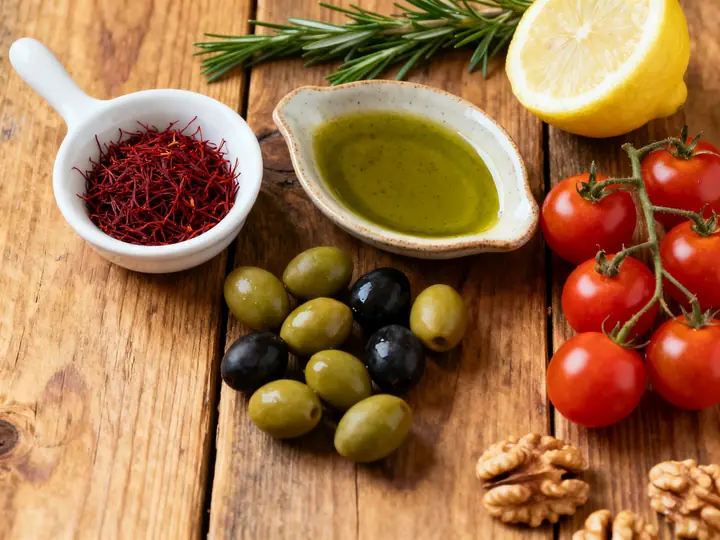
Saffron is the red thread that turns paella golden. It comes from the crocus flower Crocus sativus1, and it has picked up a reputation as a "memory spice." Here is what the research supports so far.
The short version
- Saffron: only four small trials (203 people with Alzheimer's or mild cognitive impairment); in the one placebo-controlled trial it did better on thinking tests, but there isn't enough evidence to recommend it1. Details below
- Mediterranean and MIND diets: mixed evidence2; good for your heart, not a proven memory treatment. Details below
- Olive leaf and Moro orange extracts: we found no human memory studies strong enough to describe.
- Diet isn't on the 2024 list of 14 changeable risk factors3; hearing, blood pressure, diabetes and inactivity are.
- The habits with the strongest evidence cost nothing. Details below
Phytomem One review: what's in it and what the evidence says
We reviewed the maker's pages, terms and the published research. We did not take or test the product and have no customer results to report.
Phytomem One at a glance
What it is: a dietary supplement its maker calls a "10-in-1" formula, one a day with food.
Ingredients the maker lists: saffron extract; fucoxanthin and fucoidan (brown seaweed); oleuropein (olive leaf extract); berberine HCl; Ceylon cinnamon bark; corosolic acid (banaba leaf); kudzu flower extract; Morosil (Moro red orange extract); xylitol. Amounts are not published.
Price on the maker's page (October 28, 2026):
- 2 bottles: $79 each, $158 total, + small shipping fee
- 3 bottles: $59 each, $177 total, free US shipping
- 6 bottles: $49 each, $294 total, free US shipping
One-time purchase, not a subscription, per the maker; three e-books included. Prices can change.
Refund: 60-day money-back guarantee. Under the maker's written refund policy you send all the bottles back within 60 days of delivery; items not in their original condition (opened bottles, for example) may get only a partial refund; return shipping is on you; and shipping fees aren't refunded. Order help: ClickBank, the retailer, at clkbank.com.
What the evidence says
- No supplement is proven to prevent dementia. NIH: direct evidence that dietary supplements can prevent Alzheimer's disease or other forms of dementia is lacking4. NIA urges caution with memory supplements5; ask your doctor first.
- No published trial of Phytomem One in PubMed6 or ClinicalTrials.gov7 (searched October 28, 2026). The FDA does not approve supplements before they are sold8.
- Berberine and cinnamon are studied for blood sugar, not memory. A 46-study review found berberine may lower blood sugar in type 2 diabetes9, but NIH calls the evidence for both weak.
- Saffron: a 2020 review found only four small trials (203 people with Alzheimer's or mild cognitive impairment). In the one placebo-controlled trial saffron did better on thinking tests; in two it did about as well as standard Alzheimer's drugs; the authors said there isn't enough evidence to recommend it1.
- The rest: no human memory studies strong enough to describe; doses are unpublished.
- The maker's page makes stronger claims than the evidence above supports.
Opens the maker's page, which starts with a video presentation; on some versions the prices appear after the video. Our price summary is in the review above. Orders are processed by ClickBank.
We earn a commission if you buy through this button. It doesn't change your price.
What saffron studies found
A 2020 review found only four small trials (203 people with Alzheimer's or mild cognitive impairment). In the one placebo-controlled trial saffron did better on thinking tests; in two it did about as well as standard Alzheimer's drugs; the fourth, in mild cognitive impairment, compared saffron with no treatment and was of poor quality. No serious side effects were reported. The authors said there isn't enough evidence to recommend it1.
None of the trials looked at healthy people trying to protect their memory.

What about the Mediterranean diet?
The National Institute on Aging describes the evidence as mixed. Some observational studies found that people who eat a Mediterranean diet have a lower risk of dementia2, and the MIND diet (a blend of the Mediterranean and DASH diets) has been linked with slower decline in some studies. But a recent clinical trial found only small improvements in thinking, similar to a comparison diet. So a Mediterranean-style plate is a good choice for many reasons, including your heart, but not a proven memory treatment.
Olive leaf extract (oleuropein) and Moro red orange extract come up in some memory products too. We did not find human memory studies on either that were strong enough to describe here.
What the bigger picture says
Diet is not on the 2024 Lancet Commission's list of 14 changeable risk factors3 for dementia. Hearing loss, high blood pressure, diabetes, high LDL cholesterol, inactivity, smoking, heavy drinking and social isolation are; the Commission estimated that tackling all 14 could potentially prevent 45% of future dementia3, across whole populations.

Habits that help
No quick fixes and no guarantees, just the steps with the most research behind them. Most cost nothing.
- Move most days. The CDC advises adults 65 and older to get at least 150 minutes a week of moderate activity14, like brisk walking, plus muscle-strengthening on two days and some balance work.
- Get your hearing checked. About a third of older adults have hearing loss, and it is linked with a greater risk of dementia15. In one analysis, people who used hearing aids had a lower risk of long-term cognitive decline.
- Know your blood pressure. High blood pressure often has no symptoms you can see or feel2. In the SPRINT MIND trial of people 50 and older with high blood pressure (people with diabetes or a past stroke were not included), a lower treatment goal reduced the risk of mild cognitive impairment, a secondary outcome; the main outcome, dementia, did not change significantly16. Ask your doctor what your target should be.
- Protect your sleep. Older adults need about seven to nine hours a night17, and sleep problems can cause memory problems5 of their own.
- Stay in touch with people. In an NIA-funded study of over 7,000 people 65 and older, high social engagement was linked with better cognitive health2.
- Keep learning. In one study2, older adults who learned quilting or digital photography improved their memory more than those who only socialized.
- Look after your eyes, cholesterol and blood sugar. Untreated vision loss, high LDL cholesterol and diabetes are all on the 2024 list3, and NIA advises managing chronic conditions and treating hearing or vision loss2.
- Don't smoke, and go easy on alcohol. Both are on the Lancet list3 too.
When to see a doctor
Forgetting things now and then is common at any age5. Serious memory problems are different: they make everyday things hard5, like driving, using the phone or finding the way home. The National Institute on Aging compares them like this:
| Usually normal with age | Worth a doctor's visit |
|---|---|
| Making a bad decision once in a while | Making poor judgments and decisions a lot of the time |
| Missing a monthly payment | Problems taking care of monthly bills |
| Forgetting which day it is and remembering later | Losing track of the date or time of year |
| Sometimes forgetting which word to use | Trouble having a conversation |
| Losing things from time to time | Misplacing things often and being unable to find them |
NIA also lists these signs that it may be time to talk with a doctor:
- Asking the same questions over and over again
- Getting lost in places you used to know well
- Having trouble following recipes or directions
- Becoming more confused about time, people and places
- Not taking care of yourself: eating poorly, not bathing, or behaving unsafely
Many causes can be treated. Memory problems can come from things other than dementia, and NIA says these problems usually go away once the condition is successfully treated5. Causes include:
- Side effects of medicines
- Low vitamin B12 or not eating enough healthy food
- Thyroid, kidney or liver problems
- Sleep problems
- Depression and anxiety
- Alcohol or drug misuse
- A head injury, such as a concussion
- Blood clots, tumors or infections in the brain
Big life changes, like retiring or losing a spouse, can also leave people forgetful for a while. If memory problems last more than a few weeks, talk with your doctor5. NIA's free ADEAR Center answers questions at 800-438-4380.
So, is it worth trying?
If you've covered the basics and your doctor agrees, the 60-day refund lets you judge it for yourself rather than take anyone's word for it, ours included; keep the bottles and packaging in case you send them back (opened bottles may get only a partial refund under the maker's policy). If you're unsure, the habits on this page have the strongest evidence, and they're free.
Before you tap: Opens the maker's page, which starts with a video presentation; on some versions the prices appear after the video. Our price summary is in the review above. Orders are processed by ClickBank. Please read our safety box first.
See Phytomem One's price & 60-day guaranteeWe earn a commission if you buy through this button. It doesn't change your price.
These statements have not been evaluated by the Food and Drug Administration. This product is not intended to diagnose, treat, cure, or prevent any disease. Claims on the maker's page have not been evaluated by the FDA either, and the FDA does not approve dietary supplements before they are sold. This article is general information, not medical advice.
Sources (17)
- Ayati Z, et al. Saffron for mild cognitive impairment and dementia: a systematic review and meta-analysis of randomised clinical trials. BMC Complementary Medicine and Therapies. 2020;20:333. pmc.ncbi.nlm.nih.gov/articles/PMC7650148/
- National Institute on Aging. Cognitive Health and Older Adults. www.nia.nih.gov/health/brain-health/cognitive-health-and-older-adults
- Alzheimer Europe. 2024 Lancet Commission underscores the potential for dementia risk reduction, identifying 14 modifiable risk factors across the life course. www.alzheimer-europe.org/news/2024-lancet-commission-underscores-potential-dementia-risk-reduction-identifying-14-modifiable
- National Center for Complementary and Integrative Health (NIH). 7 Things To Know About Dietary Supplements for Cognitive Function, Dementia, and Alzheimer's Disease. www.nccih.nih.gov/health/tips/things-to-know-about-dietary-supplements-for-cognitive-function-dementia-and-alzheimers-disease
- National Institute on Aging. Memory Problems, Forgetfulness, and Aging. www.nia.nih.gov/health/memory-loss-and-forgetfulness/memory-problems-forgetfulness-and-aging
- PubMed search for "phytomem" (no results on October 28, 2026). pubmed.ncbi.nlm.nih.gov/?term=%22phytomem%22
- ClinicalTrials.gov search for "phytomem" (no results on October 28, 2026). clinicaltrials.gov/search?term=phytomem
- U.S. Food and Drug Administration. Questions and Answers on Dietary Supplements. www.fda.gov/food/information-consumers-using-dietary-supplements/questions-and-answers-dietary-supplements
- National Center for Complementary and Integrative Health (NIH). Diabetes and Dietary Supplements: What You Need To Know. www.nccih.nih.gov/health/diabetes-and-dietary-supplements-what-you-need-to-know
- National Center for Complementary and Integrative Health (NIH). Goldenseal: Usefulness and Safety. www.nccih.nih.gov/health/goldenseal
- Bathaei P, Imenshahidi M, Hosseinzadeh H. Effects of Berberis vulgaris, and its active constituent berberine on cytochrome P450: a review. Naunyn-Schmiedeberg's Archives of Pharmacology. 2025;398(1):179-202. pubmed.ncbi.nlm.nih.gov/39141022/
- Wu X, et al. Effects of berberine on the blood concentration of cyclosporin A in renal transplanted recipients. European Journal of Clinical Pharmacology. 2005;61(8):567-572. pubmed.ncbi.nlm.nih.gov/16133554/
- U.S. Food and Drug Administration. Paws Off Xylitol; It's Dangerous for Dogs. www.fda.gov/consumers/consumer-updates/paws-xylitol-its-dangerous-dogs
- Centers for Disease Control and Prevention. Older Adult Activity: An Overview. www.cdc.gov/physical-activity-basics/guidelines/older-adults.html
- National Institute on Aging. Hearing Loss: A Common Problem for Older Adults. www.nia.nih.gov/health/hearing-and-hearing-loss/hearing-loss-common-problem-older-adults
- SPRINT MIND Investigators. Effect of intensive vs standard blood pressure control on probable dementia: a randomized clinical trial. JAMA. 2019;321(6):553-561. pubmed.ncbi.nlm.nih.gov/30688979/
- National Institute on Aging. Sleep and Older Adults. www.nia.nih.gov/health/sleep/sleep-and-older-adults